.png)
Digital Transformation
Risk & Compliance
Customer Experience
This was one of the main themes at our recent Mail Metrics Manchester Briefing on Consumer Duty and customer understanding. Michael Lawrence, Consulting Lead at Ocorian and a former FCA supervisor who helped develop the Consumer Duty, was joined by Sara Cody of Linklaters, Denise Crossley, Non-Executive Director at Data on Demand and Snap Finance UK, and Susan Bowman, Head of Digital UK & Ireland at Mail Metrics; with Ian Allan, Executive Director of Client Growth chairing the event.
Across the morning, our speakers approached the subject from different perspectives, but the discussion kept returning to the same point. Firms need to look beyond whether a communication has been sent and understand what happens to the customer afterwards.

Who is your customer?
It is difficult to demonstrate customer understanding if you don’t understand the customer in the first place. Age and product holdings only tell part of the story. Financial capability, existing knowledge, digital confidence, literacy and vulnerability can all affect how somebody understands and responds to a communication.
Michael highlighted the importance of the Consumer Duty requirement for communications to be “likely to be understood”. This means considering the intended audience, including what they already know and where misunderstandings are likely to occur.
One example discussed was an investment business that used different messaging for different types of investor. Experienced investors received one type of communication, while less frequent investors, who might be more concerned by market movements, received another. The subject was the same, but their information needs were different.
The discussion around vulnerability widened this further. Low financial or written literacy and low digital confidence can all affect someone’s ability to navigate a customer journey. These characteristics also aren’t necessarily fixed. Firms therefore need to keep checking whether their personas and customer cohorts still reflect the people they serve, and whether their communications reflect their needs.

What does that customer actually need?
Once you understand the customer, the focus shifts to what they need from the communication.
Regulated firms naturally have information they are required to provide. But including all the necessary information does not guarantee that the customer will understand what matters.
Michael illustrated this with the story of an elderly relative who received an important, time-sensitive letter from a financial services provider. The letter had presumably passed the appropriate internal checks and was successfully delivered. But it looked like marketing material, had a generic heading and didn’t explain the required action until page three.
She put it to one side.
Fortunately, Michael happened to see the letter and helped her deal with it. From the firm’s point of view, the process may have worked perfectly. From the customer’s point of view, the communication had failed.
A better starting point is the customer’s information need. The purpose of the communication, the important information, the action required, the deadline and the available support should all be easy to identify.
The panel also discussed the idea of “positive friction”. Removing every step from a digital journey isn’t always desirable. There are times when asking a customer to pause and consider important information can help them understand what they are buying, signing up to or being asked to do. The aim is not always the fastest possible journey, but one that supports an informed decision.
Design the journey around the outcome
This thinking needs to happen when the journey is designed, rather than once the final communication is ready to go. Michael made the case for integrating communications into the product design, so that customer understanding is considered from the outset rather than treated as an administrative step at the end.
Susan was particularly clear on the importance of looking at the journey as a whole. Doing the heavy lifting at the design stage allows firms to consider the purpose of each communication, the role of each channel and the points where customers may need additional support.
This doesn’t mean defaulting to digital. Denise argued that people can become frustrated when they are continually pushed down digital journeys. An email may be convenient and inexpensive, but it isn’t effective if the customer ignores it. Print may get noticed where an email does not, while some situations will still require a conversation.
The right channel can also improve the economics of the journey. If customers receive clear information in a format that works for them, fewer may need to call the contact centre for clarification. The objective should therefore be effectiveness rather than simply moving volume from one channel to another.
Designing in this way requires different perspectives around the table. The discussion highlighted the value of bringing together compliance, customer experience, channel, strategy and technology teams. Agreeing the intended outcome and setting clear guardrails gives those teams a common problem to solve.
Sent, delivered and opened. But did it work?
This is where measurement becomes important. Delivery rates, open rates and clicks provide useful evidence, but none proves that a customer understood the communication or successfully completed the journey.
The starting point is being able to show that a communication was approved and sent. Firms can then demonstrate delivery and engagement. Stronger evidence shows whether customers understood the communication and whether action was taken when problems were identified. Ultimately, firms should be able to connect the communication with the customer outcome that followed.
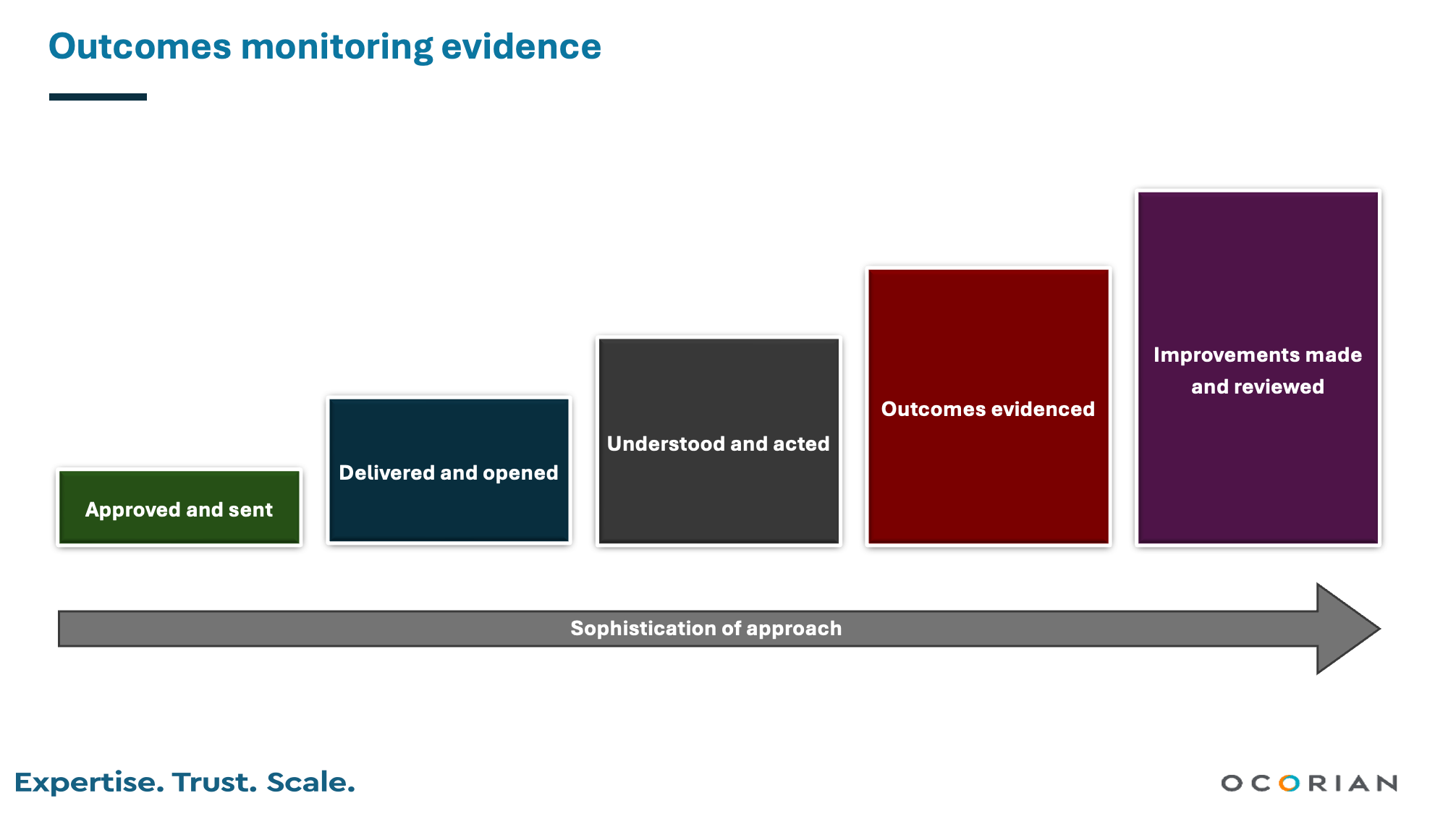
The panel described this in another useful way: the difference between the regulatory outcome and the human outcome. The regulatory outcome shows that the required process has been followed. The human outcome looks at the effect on the person receiving the communication.
Testing is therefore about more than checking that a message arrived. Interviews, surveys and comprehension testing can provide direct evidence, while existing operational data can also reveal where communications aren’t working. Abandonment, repeat enquiries, complaints and contact-centre activity can all provide useful signals.
An audience member raised an important practical issue here: testing needs to happen quickly. Firms cannot wait six months every time they need to find out whether a communication works. Testing needs to be proportionate and practical enough to become part of normal communications work.
Turn data into useful management information
Collecting more data isn’t necessarily the answer. Most organisations already have plenty of it. The challenge is turning it into information that helps people make decisions.
Denise made this point through the example of board reporting. A board pack can show everything as green, but senior leaders need to understand what sits underneath those headline measures. A healthy delivery or open rate can hide customers who aren’t progressing through the journey or groups that are experiencing very different outcomes.
This is where management information (MI) becomes more valuable than data alone. It should help firms identify patterns, exceptions and areas where something needs to change.
There also needs to be a feedback loop. Firms should be able to define the intended outcome, design and deliver the communication, measure what happened and use those findings to improve the next version.
Sara brought another dimension to this: firms need to be able to defend the decisions they make if they are challenged later. That requires good documentation and evidence. Showing that a communication was sent and delivered may not be enough if the question becomes whether customers understood it and what happened as a result.
This becomes particularly important when organisations are dealing with complex systems or the legacy of mergers and acquisitions. The evidence trail needs to show not just what the organisation intended to happen, but what actually happened to its customers.
Don’t boil the ocean: start with one journey first
For firms with hundreds of thousands of communications, multiple systems and years of legacy processes, all of this can quickly start to sound like a huge transformation project.
Susan’s advice was simple: don’t boil the ocean.
There is no need to begin with a multimillion-pound digital transformation programme. Start with a specific journey that is important enough to matter but focused enough to change. Identify the customer group and the outcome you want to improve, bring the right people together and test what happens when you make a change.
There is also room to innovate. The FCA's Innovation Pathways can help eligible firms understand how regulation applies when they are developing genuinely innovative products or services. For propositions that are ready to be tested with real consumers, the FCA also operates its Regulatory Sandbox. The message from the discussion was that regulation should not automatically become a reason to avoid trying something new.
This creates an opportunity to test new approaches to customer communications on a manageable scale. A different channel mix might reduce avoidable calls. A redesigned communication might increase the number of customers who take the right action. New technology might help identify where particular groups are struggling. Firms can test the idea, measure the human and regulatory outcomes, and use the evidence to decide whether to scale it.
For Mail Metrics, this is where technology and communications expertise come together. When the audience was asked which technology change had made the biggest difference, Single Customer View emerged as a clear theme. Denise highlighted the value of seeing communications from the customer's perspective, rather than through individual systems and teams.
Without a Single Customer View, marketing, service, regulatory and remediation communications can all land separately, leaving the customer buried in messages. Bringing that information together gives firms a better foundation for designing journeys, choosing channels and testing new approaches based on what the customer is actually experiencing.
Small steps don't mean small ambitions. They can provide the evidence needed to make bigger decisions with more confidence.
From communication control to customer outcomes
The message from Manchester wasn’t that delivery, open rates or traditional communications metrics no longer matter. They do, but they only tell part of the story.
Michael’s regulatory perspective showed why firms increasingly need evidence of what happens after a communication is sent. Sara highlighted the importance of being able to evidence and defend the decisions behind it. Denise brought the discussion back to trust, transparency and understanding what the numbers are really telling you. And Susan made the case for designing better journeys and improving them in manageable steps rather than waiting for wholesale transformation.
Together, those points lead to a more useful way of thinking about customer communications. They are not simply an operational output. They are part of how customers experience a product or service, and they can have a direct effect on understanding, engagement and trust.
There is a commercial benefit too. Better communications can reduce avoidable calls, complaints and remediation. They can help customers complete journeys successfully and make informed decisions. Getting the human outcome right can also help deliver the regulatory outcome.
Where do you start?
You don’t need to transform every customer journey at once. Choose one that matters, define the outcome you want it to achieve and establish what evidence you currently have that it is working. That gives you somewhere practical to start.
Our Manchester Briefing brought together regulatory, legal, customer and digital perspectives to explore what customer understanding means in practice. We’ll continue these conversations at our upcoming Mail Metrics events, looking at the practical steps regulated organisations can take to improve customer communications and demonstrate better outcomes.
Join us at our next event Communicate 26: Scaling Trust in the Age of AI to continue the conversation.
.png?height=2000&name=shape%20(2).png)
Contact us
Get in touch with one of our solution consultants to discuss your regulated communication requirements.